SEARCH ON WEB

Showing posts with label Biology. Show all posts

Saturday, June 23, 2012

Cell Nucleus

* Cell Nucleus act as the brain of the cell
* It helps to control eating breathing like things
* Many cells have one nucleus and some have many
* Usually it has a Globular shape
* In animal Cells it is in the middle but in plant cells it is shifted to a side
* All cells do not have nucleus
* Only  eukaryotic  cells having it that is why it it is call as Nucleus cells
* Cell nucleus can divide in to two by its own.
* Nucleus division occur when Cell division occur let's discuss it under Cell division
* Parts of a nucleus
  • Nucleus Membrane
  • Nucleolus
  • Chromatin
Nucleus membrane
 Nucleus membrane around the nucleus protects the nucleus from mechanical and other injuries.
2 parts of it
         inner membrane
         outer membrane


Chromatin
Chromatin contains Protein,RNA and DNA which controls the functions of the Cell.
Nucleolus  
RNA and protein makes the Nucleolus it is inside the nucleus
.
*Apart from above parts nucleus plasma fills whole nucleus.


      Structure of the nucleus 

Saturday, March 3, 2012

Significant Differences Between Plant Cell & Animal Cell

Plant Cell Animal Cell
  • Have Chloroplast
  • Involve in photosynthesis
  • Have Cell wall made with Cellulose
  • One very large vacuole in the center
  • Rectangular shape
  • Do not have Chloroplast
  • Don't involve in photosynthesis
  • No Cell wall
  • Small vacuoles
  • No shape

Plant Cell

Outer boundary is cell wall
Plant cell have a cell wall
Having Chloroplasts for photosynthesis
Eukaryotic cells
basic structure is same to animal cell


Consists with
Cell wall
Chloroplast
Endoplasmic Reticulum
Golgi
Nucleus
Ribosomes
Vacuole 


Monday, November 28, 2011

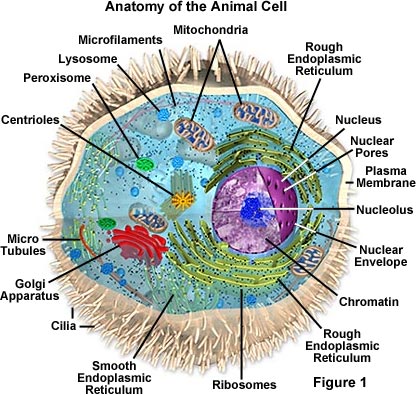
Animal Cell

Animal cells are typical Eucaryotic cells
Enclosed by a plasma membrane and containing a membrane-bound nucleus and organelles
Animal cells do not have a Cell wall
Both plant and animal cells ranged between 1-100 micro meters
These cells cant see by unaided eye and we have to use compound microscope to observe animal cells
Above picture shows the structure of typical animal cell. But cell to cell above structure can be different and that is only the typical cell structure.
Now lets see what are the organelles we can see in these cells.
Plasma-membrane
Cell Plasma
Endoplasmic Reticulum
Golgi aparates
Lysosomes
Nucleus
Peroxisomes
Mitochondria
Ribosomes
After discussing about plant cell in my next blog post I will show you about each organelles later


Saturday, November 26, 2011

Differences between Prokaryotic and Eucaryotic

Prokaryotic Cells
Small cells comparing to Eucaryotic cells
Always unicellular
No Nucleus
No any membrane-bound organelles ( Like mitochondria)
DNA is circular and do not combine with Histone
Ribosomes are small (70s)
No cytoskeleton
Cell division by binary fission
Reproduction is asexual


Eucaryotic Cells
Larger Cells comparing to prokaryotic cells
Often Multicellular
Always have Nucleus
DNA is combined with Histone
Ribosomes are large (80s)
There is a cytoskeleton
Cell division is by mitosis or meiosis


Wednesday, November 23, 2011

Kingdoms of Biology

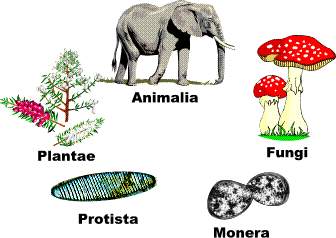
When we consider living organisms there are several groups. Some animals have different characteristics. So according to the characteristics of living organisms they are categorize in to 5 Kingdoms
Monera
Protists
Fungi
Plantae
Animalia

Monera
Monera is single cell organisms. eg: Bacteria, Cynobacteria. Among all the living organisms bacteria are the most common living organism is Bacteria. Bacteria are also known as living fossils because they are present on earth more than 20000 years not facing to any differences.

Protists
This is another living organism type. Many of them are single cells. Some are moving and some are not moving.

Fungi
Motionless living organisms which absorb nutrients.

Plantae
Multi celled organisms. Green organisms. They use photosynthesis process to provide energy. Cell walls are created with cellulose

Animalia
Most complex living organisms on earth. Multi-cell organisms.Cant produce food using sunlight use organic matter as source for food.

Monday, November 14, 2011

What is chromosome?

In the nucleus of each cell, the DNA molecule is packaged in to threat- like structures called chromosome. Each chromosome is made up of DNA tightly coiled many times around proteins called histones that support its structure.
Chromosomes are not visible in the cell nucleus not even under microscope when the cell is not dividing. However the DNA that makes up chromosomes become more tightly packed during cell division is then visible under microscope.

DNA finger printing

The Chemical structure of everyone,s DNA is same.
The chemical structure of man and animals are also the same.
The Different between animals and within people is also generated by DNA, So how it happens if DNA structure is same...
That happens like this
although the chemical structure of a DNA is same order of the base pairs of DNA is different. This will occur the differences between animals.
every person has different sequence of DNA to identify a person scientists have to recognize this sequence of millions of DNAs so scientists use short method to do that because of repeating pasterns in DNA
This method will not able to recognize people separately but will able to recognize whether the two DNA samples are from same person.

What is Life

The entire scientist tried to give a simple definition to life. These scientists were not succeeded according to the knowledge they have gathered they came to know that life can’t define simply. So they compared living and non living things to define life.
1. Living things has an organized structure
When we consider any living thing it is made with organized structure. Atom > Cell > Tissue > like that. Cell is the smallest living thing. It is made with number of atoms and consists with sub cell structures like (mitochondria, ribosome)
2. Living things can involve in reproduction
Every living thing can reproduce. As a living been ends its life in someday they involve in reproduction which can produce another living been which has the same qualities of their parents.
3. Living things will respond to their environment.
Living things can respond to the environment. We know this from the experience we will move to shade if there is too much of sunlight. Plants will wilt if there is no water.
4. Living thins can grow and develop
Living things are growing and developing. This can’t do by non living things.
5. Living things can adapt to the nature
Living things will adapt according to their living places. Mammals live in cold areas have more boozy skin comparing to other mammals.
6. Living things need energy
Every living thing needs energy to continue their lives.
7. Living things can move
Every living thing can move, even a plant. Although we can’t see plants are walking water and nutrients are moving in their xylems.
8. Living things can involve in evolution
9. Living things have biological & chemical reactions inside them.

What is Biology?

Bio – living Logy- study so studding about living things is simply known as biology. Biology is the basic foundation to even study Medicine. Lot of universities and schools provide the facility of learning biology for students for their higher studies. Biology can divide in to two parts as Zoology and Botany. As I am a undergraduate in Agriculture this blog may focus more in to Botany. What is Zoology? Zoology is the study about animals and botany is the study of Plants. Usually living things can be categorize in to five kingdoms Monera ,Protista ,Fung,i Plantae, Animalia . In Biology we can discuss about these kingdoms. Other than zoology and botany students can study morphology and physiology of living organisms. Students will able to learn about structure of a living organism under morphology and under physiology they will learn about the functions inside the living organisms.
If we think about the history of biology we can’t exactly tell when it began. Our ancestors may get some knowledge about plants and animals living around them and they may gather information about those plants and animals. This may be the beginning of Biology. With the arrival of Greek civilization people has started to search for reasons cause for the result. People started to believe their should be a reason for every effect. This way of thinking made the foundation of science and biology is a branch of science. This science is the science of life. So Biology also developed with science step by step. After people found microscopes to observe micro organism Micro biology also developed as a science. After the invention of electronic microscopes which is more powerful than light microscope people found more about structure of plant and animal cells and about cell division like things. So here with this blog notes I will help you to improve your biological knowledge.